


25 Way to Save Money on Food ...And Eat Healthy Book
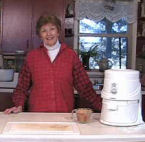
Watch Sarah's video on the Nutrilmill. The Nutrimill grinds wheat, barley, oats, beans, and corn. |
 |
|
Berkey Water Purifier offers pure water for healthy families.|
Quickly preserve healthy fruits and vegetables|
25 Ways to Save Money On Food.... And Eat Healthy. The book that save you big money. |
Biblical Health & Nutrition Manual|
Read about Sarah's Biblical Health & Nutrition Manual in the Chinese language|
 We know by the popularity of our 25 Ways to Save Money on Food page that this is a hot topic. We have seen a lot of "save money on food" lists in magazines and on the internet. These are good ideas and will save you money if you're willing to eat what is being offered. The sad fact is that most food manufacturers, grocery stores, chain restaurants and convenience stores do not have your health in mind. Their goal is profit and repeat business. What you get is expensive food that sustains life, but not health. To effectively save money and eat healthy, you need to eliminate these middlemen or at least be aware of their tricks.
People are tired of being sick and tired - and paying for it. Our book covers ways to eat healthy and save you money on your food bill. It will also teach and train you to make healthy food choices. The results of living the 25 Ways To Save Money on Food ...And Eat Healthy will amaze you. We have been practicing these ideas for over thirty-years and KNOW they work. The book includes ideas, recipes, organization aids and planning areas for your own goals. We encourage you to buy the book, do the stuff, and enjoy the benefits.
There are twenty-five chapters in the book. Each chapter is from one to seven pages in length. Each chapter includes a "homework" assignment that challenges you to put the idea to use. You plan your work, and then, work your plan. Some of the chapters include pictures of the ideas in practice at Milk and Honey Farm. We have been living this lifestyle for thirty-years. It works for us!
WATCH THE 25 WAYS VIDEO
The video should start in a moment or two. If you have a slower connection, try downloading one of these video files.
Click here to read the original 25 Ways To Save Money on Food page.
An Excerpt from 25 Ways to Save Money on Food ...And Eat Healthy
Chapter Seventeen
I LOVE MY PANTRY
“Go to the ant you sluggard! Consider her ways and be wise; which having no captain, overseer or ruler, provides her supplies in the summer, and gathers her food in the harvest.” Proverbs 6:6-8
If I could be a bug, I would like to be an ant. Ants are very organized. They gather food in the summer and store it in their pantries for the winter.
I have kept some form of a pantry for over thirty-years. They have varied in size and content. Some of my pantries consisted of card board boxes filled up with canned goods. Other pantries were the back of a closet, or under the bed. I have had a pantry when living in a tiny apartment in downtown Dallas, Texas. I have had a pantry living with a lot of hippie types in a barn in Southern Ohio. I had a pantry when my home was in the suburbs. I have had a pantry when I had a shortage of funds. I have had a pantry when I had much more than enough. I keep a pantry now.
Organization and discipline have not always been easy for me, but I have learned well. It really annoys me to run out of something. It is also a good excuse for not starting or finishing a project. It irks me to need something and not have it available or accessible. A good example is living in Minnesota, where winter survival can be a challenge. It is not always possible to drop everything and go to the grocery. The weather can be 30-degrees below zero, the wind howling, the snow coming in buckets. It is not fun to navigate the highways with hungry, cold children in the car, because you ran out of cereal, peanut butter or diapers.
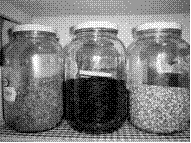 My pantry is well stocked. It consists of dried foods like flour, beans, rice, and pasta. It has canned foods, like soup, tuna, fruits and vegetables. It has a good supply of dried fruits and nuts. It has cooking oil and vinegar. It has bottled water, tea and fruit juice. It has paper goods (toilet paper, paper towels, paper plates, cups) spoons and forks. It has cleaning products like laundry and dish soap, and all purpose cleaners. It has shampoo and bar soap. It has first aid supplies, including band aids, iodine, and aspirin. Bug spray and sun block are there, too.
My pantry stays full. I never, never run out of these basics. On the wall inside the pantry, is a board where I keep lists of things to buy. When I get close to running out of something, I list it on the board. This simplifies my busy life. I am never out of anything and my household runs smoothly.
Each family is unique. Each family has different needs and requirements. Everyone needs a pantry. If you don’t have one, get one. It may save your life.
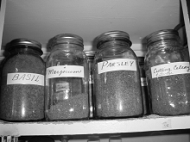 By having a well stocked basic pantry, you will save considerable amounts of money on your food bill. For example, everything in the pantry can be bought on sale. You will save money on gas with no extra trips to “grab” something. You will limit trips to the fast food joints because you always have an alternative available. It an emergency situation, you and your family will be prepared. This is important. Please pay attention.
BUY AND STOCK A FREEZER
It can be huge or very small. It can be an upright or a chest type. You can buy a new one, or pick up one at a garage sale. We bought two of our freezers at garage sales. One cost twenty-dollars and the other was forty.
Since we have a big garden and fruit trees, our freezers are stocked with produce from the farm. Our meat includes fish we have caught and lamb and chickens that we raised here. I also put up freezer meals, homemade soups and sauces. I have bread, rolls and desserts. This is easy for me as I like to cook.
If this is “not your thing” get a freezer and stock it with groceries purchased on sale and in season. Buy frozen veggies and meats at the grocery. Buy healthy frozen dinners. Bring them home and stock your own freezer. Buy some bread, some rolls, a few pizzas and you are set. Don’t forget the ice cream. I would suggest that you mark the date of purchase on each package and rotate your food every six months. You can buy yourself something special with the money you will save. This is simple.
You do not have to fill your freezer up all at once. Buy food items in season and you will save more. We get two extra turkeys for the freezer just before Thanksgiving. We like turkey and they are cheap that time of the year. Buy several items to put in your freezer each time you shop. It won’t be long before you are well stocked.
My pantry and my freezer programs are not motivated by fear. They were planned and created for an effective household to run smoothly. I am ready for unexpected company and my family is covered with” home made and home grown.”
This is my own personal means of “Homeland Security.” It works for me.
HOMEWORK
On the chart provided to make a list of what your family may need in an emergency and on a regular basis, and get busy. The peace of mind and added convenience is worth the effort.
| Food Staple | Quantity | On-Hand? | Purchase Date |
| Example: Wheat | 25 lbs. | no | Next payday |
| Example: Tomato Sauce | 8 8oz. cans | yes | 8/04 |
| Whole wheat flour | |||
| White flour | |||
| Wheat Berries | |||
| Corn meal | |||
| Oatmeal | |||